
Year 3
Welcome to Year 3
Welcome to our Year 3 page! We are delighted to work in partnership with you to create a nurturing, supportive environment where children are at the heart of everything we do. If you ever have any questions or concerns, an adult will be available after school to help. We look forward to an exciting and positive year together.

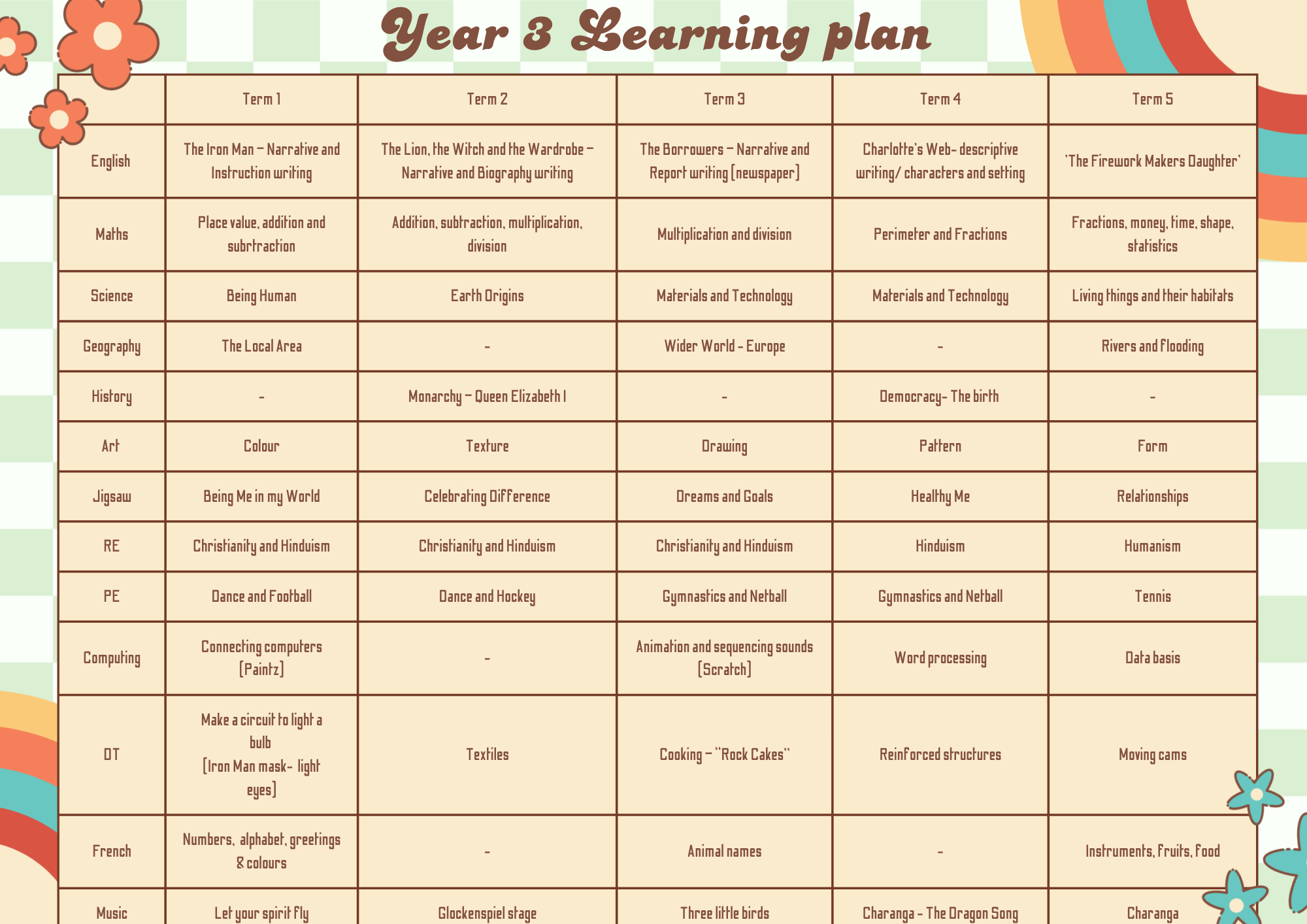
Year 3 Learning Plan
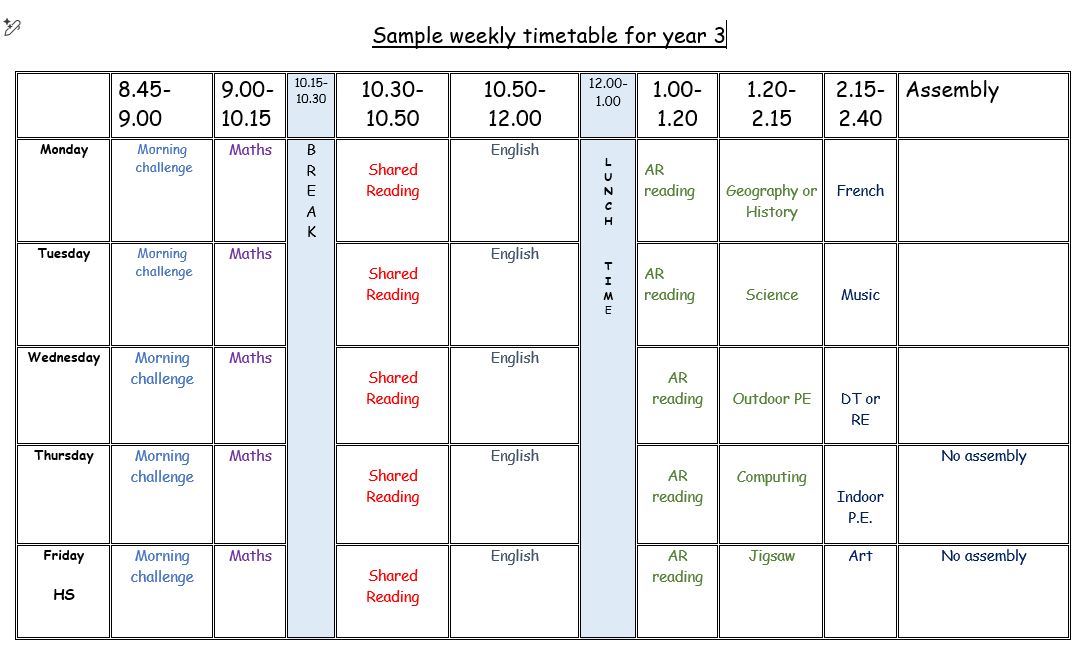
Year 3 Typical School Day
Our school day starts at 8:45am with a morning challenge which are designed to help children start their day with focus and energy.
Please make sure your child has a coat in school every day, as we endeavour to get out at break and lunchtime whatever the weather!
What have Year 3 been up to recently?
Please see the gallery below of some of the fabulous things that Year 3 children have been doing this year.


PE
Year 3 PE is an exciting and fun-filled journey where children develop their physical skills, teamwork and confidence through a variety of engaging activities.
At Ashcombe primary, Year 3 Physical Education offers pupils the opportunity to explore a range of sports and exercises that promote healthy lifestyles and active learning. Pupils engage in activities that build coordination, balance, strength and agility while also learning the importance of cooperation, respect and fair play. Throughout the year children participate in team games, gymnastics, dance and athletics, allowing them to discover new talents and develop a love for physical activity. Our PE programme is designed to be inclusive and enjoyable, helping every child grow in confidence, resilience and enthusiasm for staying active- both in and out of school.
Our PE days can change throughout the year. We will send a school Ping out in advance of each new term to confirm what days your child will take part in PE. Please ensure your child comes to school on those days wearing suitable PE kit.
Reading in Year 3
We believe that reading is a vital life skill and the foundation for all learning. In Year 3, children make the important transition from learning to read to reading to learn, building on the secure phonics and early comprehension skills developed in Key Stage 1.
Our Year 3 reading curriculum is carefully structured to support children as they develop greater fluency, understanding and confidence. Pupils are encouraged to read widely and often, exploring a range of high-quality texts including fiction, non-fiction and poetry. Through discussion and guided questioning, children are supported to talk about what they read and begin to express their ideas clearly.
Teaching in Year 3 focuses on developing fluency, vocabulary and comprehension. Children learn to read accurately and with increasing expression, while also being taught how to understand and respond to texts in more depth. As they move through the year, pupils are encouraged to think carefully about characters, settings and events, and to begin making simple inferences based on what they have read.
Children are supported to:
❇️ Read age-appropriate texts with increasing fluency and accuracy
❇️ Develop and use a growing vocabulary to understand meaning
❇️ Read aloud with expression and awareness of punctuation
❇️ Retrieve key information from texts
❇️ Answer questions using evidence from the text
❇️ Begin to make predictions and inferences based on what is stated and implied
❇️ Discuss characters, events and key ideas in a text
Reading in Year 3 includes:
❇️ Whole-class reading sessions with a focus on comprehension and discussion
❇️ AR quizzes are completed when children are reading above purple books. It's a scheme which fosters independent reading, matched to the child's reading age. Pupils take computerised quizzes on books to test for reading comprehension.
❇️ Explicit teaching of vocabulary and reading strategies
❇️ Regular independent reading to build stamina, confidence and enjoyment
❇️ Opportunities to read across the wider curriculum
Books we have read so far this year:


Reading at Home
Reading at home plays a key role in supporting children’s progress as they move into Key Stage 2.
We encourage families to:
❇️ Support regular independent reading
❇️ Listen to their child read aloud and talk about the text
❇️ Ask simple questions to check understanding and encourage thinking
❇️ Discuss new vocabulary, characters and events
❇️ Praise effort, perseverance and progress
Regular shared reading at home helps to strengthen fluency, comprehension and confidence, and supports children in developing a positive attitude towards reading that will benefit them throughout their education.
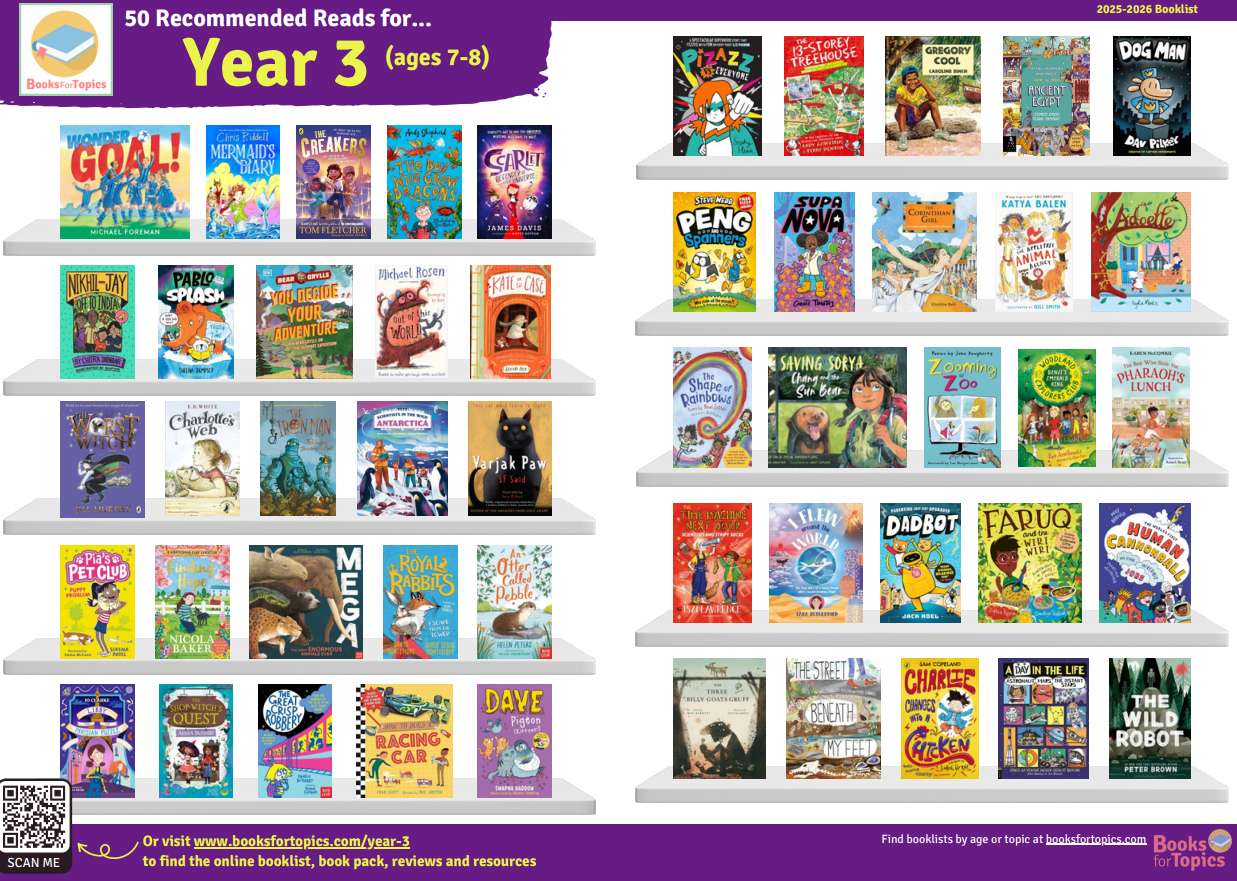
Recommended Reads:
Spellings
Children learn and practice spellings throughout the week before a retrieval quiz the following week. This is to enhance long-term memory retention and build schema.
Please see documents below which show the spellings covered in Year 3
Maths
Year 3 maths builds confidence and curiosity in children, helping them explore numbers, shapes and measurements, while developing problem-solving skills.
In Year 3, children take the next step in their mathematical journey by deepening their understanding of number concepts and learning to apply them in practical and fun ways. Pupils work on addition, subtraction, multiplication and division, and start to explore fractions, decimals and patterns. They also learn to measure length, mass, volume and time, as well as identify 2D and 3D shapes.
The focus is not only on mastering calculations but also on developing logical thinking, reasoning and problem-solving skills that they can use across different subjects and everyday life. Engaging activities, interactive lessons and practical exercises make maths enjoyable and accessible, encouraging a positive attitude toward learning and building a solid foundation for future mathematical success.
How parents can support their child in maths
Parents can support Year 3 pupils in maths at home by helping them practise key skills in fun, everyday ways. Encouraging children to use maths in real-life situations such as telling the time, measuring ingredients when cooking, handling money, or spotting patterns, this all helps build confidence and understanding. Playing simple games that involve number facts, times tables, or mental maths can also make learning enjoyable. Parents can ask their child to explain how they solved a problem, as this strengthens reasoning and deepens understanding.
Most importantly, offering praise, keeping sessions short and positive, and showing enthusiasm for maths helps children feel motivated and capable. In Year 3, children focus on learning the 2, 3, 4, 5, 6, 8 and 10 times tables. Learning multiplication facts helps children build strong foundations for related division facts and letting your child practise these regularly through games, chanting, apps, or quick daily recall can make a big difference to their confidence and fluency.
Online Programmes we use
Maths.co.uk
What it supports:
• Fluency in key maths skills
• Consolidation of learning taught in class
• Confidence with number and problem-solving
How it's used in Year 3:
Maths.co.uk is used to reinforce learning taught in lessons, allowing pupils to practice key skills such as number facts, calculations and reasoning in a structured way. Tasks are matched to age-related expectations and used to support both practice and challenge.
Impact:
Helps pupils secure core maths skills, build confidence and develop accuracy and fluency over time.
Spelling Shed
What it supports:
• Statutory Year 3 spelling rules and patterns
• Vocabulary development
• Accurate spelling in writing
How it's used in Year 3:
Spelling Shed is used regularly to practice spelling rules taught in class. Activities are engaging and age-appropriate, supporting pupils to rehearse, apply and retain spelling patterns through structured games and challenges.
Impact:
Supports progress in spelling, improves accuracy in written work, and builds confidence when using new and ambitious vocabulary.
Links to websites you can use at home

ICT games
ICT Games is a website that offers a large selection of free educational games for children aged 5 to 10. Created by an experienced UK teacher, the games follow the Key Stage 1 and 2 curriculum. This makes them useful for learning at home or supporting lessons in the classroom. Children can explore concepts in maths, English, and basic data handling while building confidence and understanding in each subject
Website: https://ictgames.com/
Mathsframe
Mathsframe is an interactive online platform designed to make learning mathematics engaging and effective for KS2 students.
It is a comprehensive educational resource that offers over 200 interactive maths games and 300 worksheets aligned with the UK national curriculum. It is designed by experienced teachers to help students grasp various mathematical concepts in a fun and engaging way.
Website: https://mathsframe.co.uk